How it Works

Traditional methods to account for and manage book reading (reading logs, journals, parent reports of their child’s reading, oral and written book reports) take much teacher time to moderate and are not reliable as they are essentially subjective.

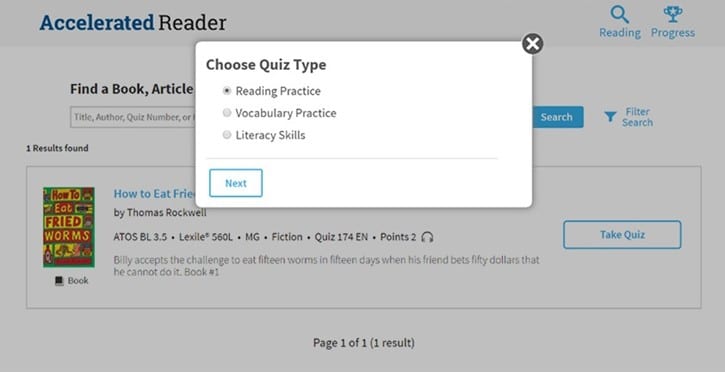
Accelerated Reader (AR) is currently used in thousands of UK schools. It was designed to make the job of managing book reading easier and more reliable, whilst also motivating pupils to read more books for pleasure. Pupils read books of their individual choice and then take AR computer quizzes to check if they have understood what they have read. In the UK, over 45,000 quizzes are currently available, and approximately 2,000 are developed and added each year. There are quizzes on most of the books children are likely to want to read, both fiction and non-fiction, from the most popular books, such as the Harry Potter series, to classics, such as Pride and Prejudice. In addition to the reading practice quizzes, there are vocabulary practice quizzes that test a child’s understanding of particular words and also literacy skills quizzes that analyse 24 different areas of higher-order thinking skills.

AR keeps track of all aspects of pupil book reading – for example, titles of the books, book readability levels and quiz scores. AR gives immediate feedback on each quiz to the children and to teachers, administrators, and parents. It also does this for all quizzes combined. This formative feedback helps teachers shape subsequent reading instruction, guide individual pupils and motivate children to continue reading. AR is thus an accurate and efficient continuous progress-monitoring system that monitors both the quantity and quality of individual book reading.

The book difficulty level is determined by the ATOS formula. This is marked on the book so pupils can make sure that they are choosing books that are not too easy or too hard – challenging without causing frustration. ATOS uses four factors to determine readability: average sentence length, average word length, word difficulty level and the total number of words in the book. The entire book is scanned, and the formula is applied to the whole book – not a small sample of text as with other formulae. ATOS can be applied to all publications. In order to relate the ATOS levels to the British system, ‘1’ would have to be added to bring the difficulty level up to English, Welsh and Northern Irish Years and ‘2’ added to bring it up to Scottish P years. The interpretation takes this into account.

To illustrate this point, ATOS was applied to about 30 text samples from some common UK publications. Interestingly, these common periodicals were not as different in terms of their average readability as might have been expected, but the range of readability of items within each one was considerable. An exception was Hello magazine, which had many text samples within a narrow range of readability as if its policy was to constrain readability deliberately. The Economist had consistently high readability text. The differences in the size of the text samples were also interesting – the Sun had some shorter but also some longer pieces, while Hello texts were even more varied.

Publication Reading Age Range Based on Word Count
The Economist 13.6 12.0 – 15.2 500 – 2,000 words
The Times 12.7 11.0 – 15.1 500 – 800 words
The Daily Mail 12.0 9.1 – 14.2 450 – 700 words
The Sun 11.5 9.7 – 13.3 350 – 1,000 words
Hello Magazine 11.4 9.5 – 13.3 250 – 2,000 words

More About Accelerated Reader

Accelerated Reader (AR) is a personalised practice and daily progress-monitoring system that helps teachers accurately and efficiently monitor pupil progress in quality (comprehension), quantity and difficulty of books read. Introduced in 1986, Accelerated Reader has become one of the most popular educational software programs in the world. While AR has become increasingly sophisticated over the years, its basic three-step approach has not changed:

  1. First, a pupil reads a book either at school or at home.
  2. Next, the pupil takes a computerised quiz of 5, 10, or 20 questions depending on the length of the book.
  3. Then, the pupil and teacher receive immediate feedback with reports detailing books read, number of words read, book reading level and level of comprehension (percent correct on the quiz).

Currently there are AR quizzes for more than 45,000 books, so pupils can read and take a quiz for the majority of the popular books available in their school or public libraries. AR also includes quizzes to assess vocabulary and literacy skills along with voice quizzes for struggling or emergent readers.


Different quiz types are available, but Reading Practice are the most popular


What Makes Accelerated Reader Special

Renaissance Learning’s online book-searching tool, AR BookFinder, which is publicly available to all who have a love of reading, makes book selection easy for pupils (as well as teachers, parents and librarians) by providing descriptions about each book for which an AR quiz is available as well as having specialised search tools so pupils can, for example, identify award-winning books or match particular interests in other areas.

AR Book Guide can be used by teachers to create recommended reading lists. This allows pupil choice, but with guided assistance from the teacher via specially assigned keycodes, to enable pupils to access a set list of books from within AR BookFinder. While it is true that Accelerated Reader helps teachers by efficiently managing all the details of pupil reading practice, for pupils it fosters the vital connection between pupils and books: that love of reading that it is so critical to pupils’ development. Research-based AR Best Practices recommend not only that pupils read books at appropriate levels of challenge and interest but also be given choice in what they read.

It is likely that pupils will frequently be assigned books to read as part of the core curriculum at their school, but it should be just as likely that pupils are able to choose to read books about topics, characters, locations and so forth that are of interest to them. Once pupils learn to read, having choice over what they read is motivational, not to mention essential, so that they learn to love to read.

Accelerated Reader Best Practices

AR is used by thousands of teachers in the UK because it saves time, motivates pupils to read and is more reliable and accurate than traditional methods of tracking pupil book reading.

AR Best Practices are research-based recommendations that educators learn through Renaissance Learning professional development services to ensure that teachers make the most of the wealth of data AR provides. This may require changes in teacher, classroom and even school practices. More time for in-school reading, establishing individualised target setting and careful monitoring of pupil reading comprehension are often required. Renaissance Learning recommends 30 minutes of daily independent reading practice for primary schools and 20 minutes of daily independent reading practice for secondary schools.

Renaissance Learning strongly recommends AR Best Practices to ensure fidelity of implementation so that pupils benefit from reading practice to the greatest extent possible. Extensive research has shown it is not just the quantity of reading or time spent reading that helps pupils read well and become well read. It is also the quality or how carefully – with what level of comprehension – they read. The more carefully pupils read the more they comprehend and the more their reading practice leads to improved reading achievement.

The research base for AR is large and diverse and has been positively reviewed by groups such as the Florida Center for Reading Research and the California Learning Resource Network. To date, more than 150 research studies and independent reviews have been published on AR, including an independent report by the Specialist Schools and Academies Trust in the UK and over 70 UK school case studies, with at least 20 articles appearing in peer-reviewed journals.

The ATOS Book Readability Level

Accelerated Reader uses the ATOS readability formula to measure the text difficulty of each book for which a quiz is available.

The ATOS readability level helps pupils, teachers and parents with the book selection process. Using ATOS, pupils can find books to read within their reading achievement range – books that are neither too easy nor too hard that will challenge them without causing frustration or loss of motivation. ATOS uses four factors to measure a book’s readability level: average sentence length, average word length in number of letters, word difficulty level and total number of words in the book. To calculate a book’s ATOS score, the entire book is scanned into a computer. The readability level is based on the full book rather than a 100-word sample sometimes used to measure readability by makers of other formulas.

Home Connect is one of the features of Accelerated Reader that allows parents and guardians to monitor what their children are reading and quizzing in school.

About the Authors

Keith Topping is Professor of Educational and Social Research at the University of Dundee and Professor of Education at RUDN University, Moscow, and researches all over the world.

He has 477 published works (books, chapters, peer reviewed journal papers and distance learning packages), with translations into 19 languages. Prior to entering Higher Education, he worked for a number of Local Education Authorities and for Social Services and Health. Keith’s own main research focus is Peer Learning (including peer tutoring, cooperative learning and peer assessment) in core skills and across subject boundaries, in all sectors and contexts of education/lifelong learning. He also has interests in computer aided assessment.

Dr Christina Clark is Director of Research and Evaluation and Irene Picton (pictured) is Senior Research Manager at the National Literacy Trust.