The authors of this Section were Christina Clark (Director of Research and Evaluation) and Irene Picton (Senior Research Manager) at the National Literacy Trust.
With nearly two decades of tracking children and young people’s reading habits, the National Literacy Trust’s Annual Literacy Survey provides a valuable long-term perspective on reading engagement. In 2024, responses from more than 76,000 participants aged 8 to 18 revealed a sharp decline in both reading enjoyment and daily reading, with the lowest levels recorded since the survey began in 2005. These trends were seen across demographic groups and have prompted renewed discussion among educators, policymakers, and others about the factors influencing reading engagement. This chapter examines these findings in more detail and considers their potential implications.
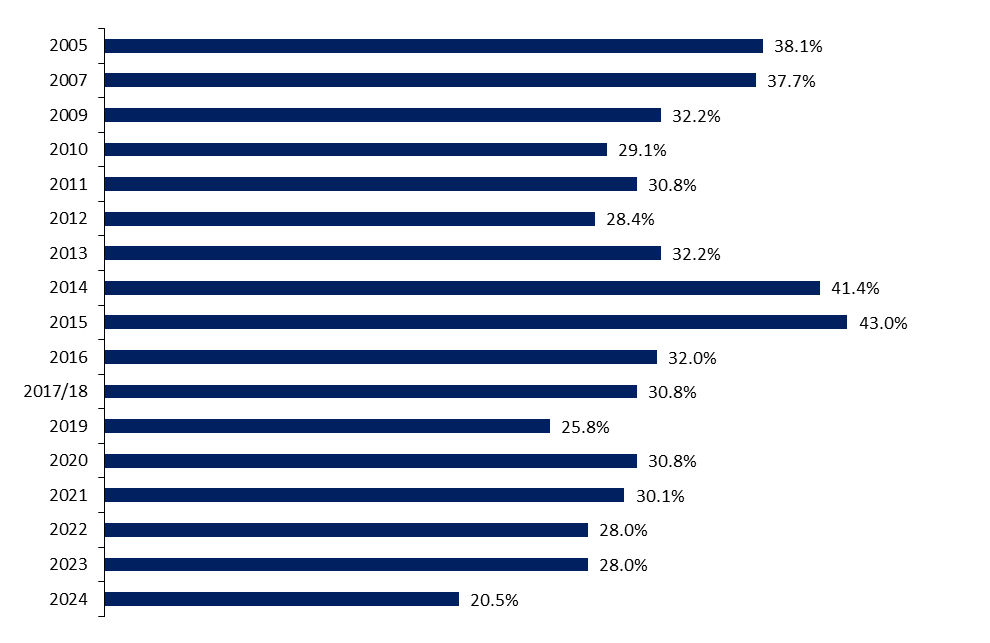
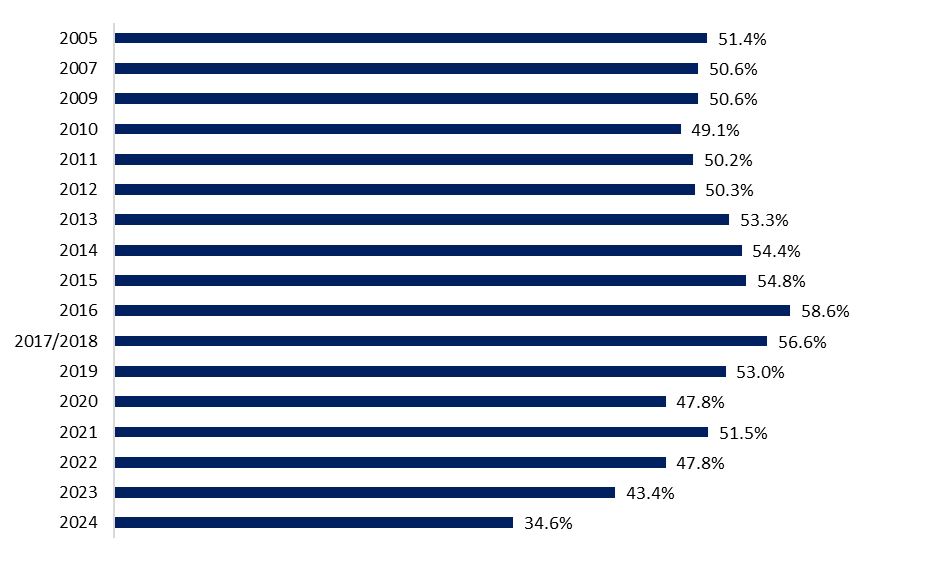
As Figure 6a shows, since we started asking children and young people about their reading enjoyment in 2005, levels remained relatively stable for many years, with around half reporting that they enjoyed reading in their free time. The highest level recorded was in 2016, when nearly 3 in 5 said they enjoyed reading. However, this peak was followed by a gradual decline, interrupted only briefly by a modest uplift in 2021, likely linked to increased reading during school closures amid the COVID-19 pandemic. This temporary rise was not sustained, and reading enjoyment has since declined steadily, and more recently, at a faster pace. By 2024, just one in three (34.6%) children and young people reported enjoying reading in their free time – the lowest level since the survey began in 2005 – and the sharpest year-on-year drop on record, with an 8.8 percentage-point decrease from 2023.
Figure 6a: Percentage of children and young people aged 8 to 18 who enjoyed reading in their free time either very much or quite a lot from 2005 to 2024
In 2023, we saw a concerning shift as reading enjoyment declined among two groups that had traditionally reported higher levels: girls and children aged 8 to 11. In 2024, while more girls than boys enjoyed reading (40.5% vs 28.5%), as in every year since 2005, we found the gender gap in reading enjoyment had tripled compared with 2023, increasing from 4.8 to 12.3 percentage points and driven largely by a greater drop in reading enjoyment for boys.
Among age groups, secondary-school-aged pupils showed the most marked declines. As in previous years, younger children reported higher enjoyment levels, with 66.5% of 5 to 8s and 51.9% of 8 to 11s saying they enjoyed reading. In contrast, only 30.7% of 11 to 14s, 29.7% of 14 to 16s, and 40.0% of 16 to 18s said the same. Reading enjoyment fell across all age groups between 2023 and 2024, but the decline was steepest among 11 to 14s (down 9.7 percentage points) and 14 to 16s (down 11.1 percentage points), compared with a smaller drop among 8 to 11s (down 4.3 points).
Enjoyment also declined for both pupils receiving free school meals (FSMs) and those who did not. However, the drop was more pronounced among non-FSM pupils, who saw a 9.2-point fall, compared with 5.6 points for those receiving FSMs. This ‘levelling down’ brought enjoyment levels between the two groups to near parity (33.9% FSM vs 34.6% non-FSM)—a gap that has only been smaller once since 2005, when it disappeared entirely in 2016.